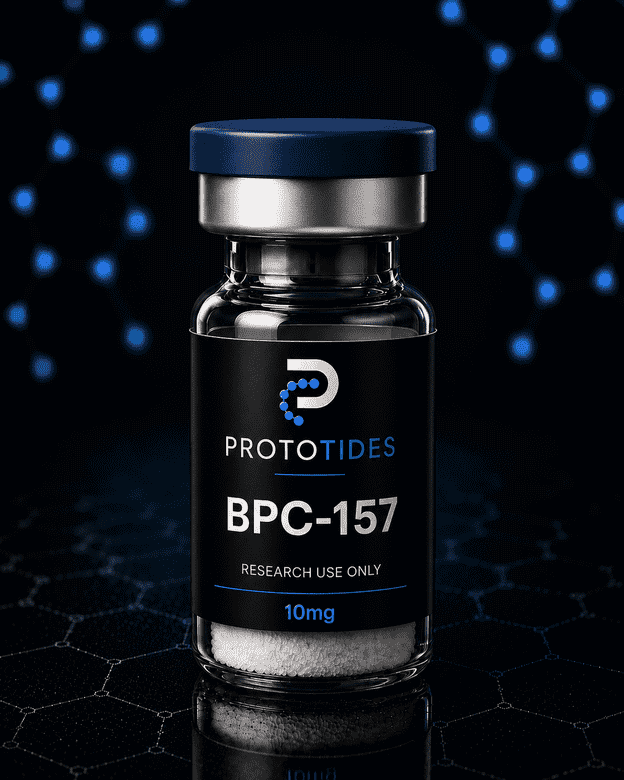
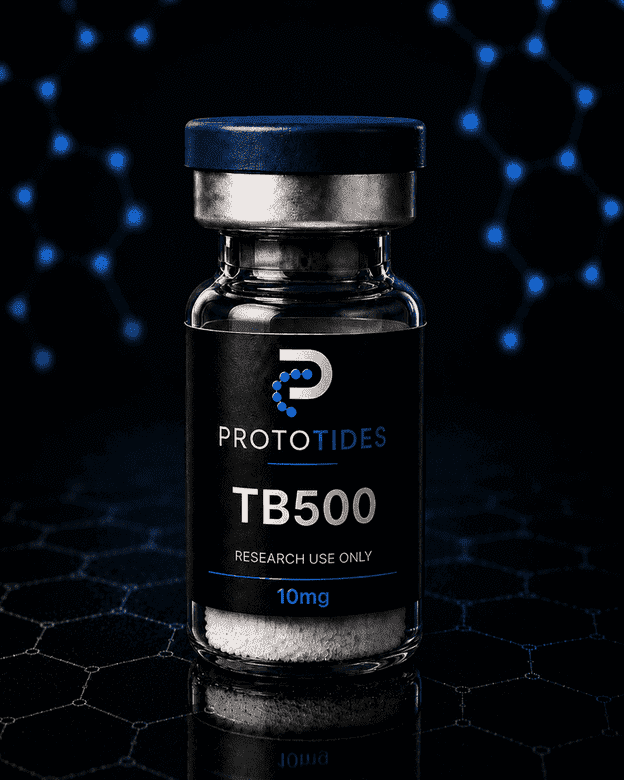
BPC-157 and TB-500 are both synthetic peptides that the Prototides catalog groups under Growth Factors. Researchers evaluating the two on paper are usually comparing two things: what each molecule actually is, and what documentation accompanies each lot. This reference addresses exactly those two questions.
It does not compare — and does not describe or imply — any biological effect, activity, outcome, or application of either compound, and neither is presented as preferable to the other. Both are supplied strictly for laboratory research use.
At a Glance
Reference values for each molecule. Lot-specific figures are always those printed on the accompanying Certificate of Analysis, which takes precedence over any general reference.
| Attribute | BPC-157 | TB-500 |
|---|---|---|
| CAS number | 137525-51-0 | 77591-33-4 |
| Molecular formula | C62H98N16O22 | C212H350N56O78S |
| Reported mass | ~1419.5 Da | ~4963.4 Da |
| Sequence length | 15 residues | 43 residues |
| Structural basis | Partial fragment of a protein described in association with gastric juice | Based on a region of the protein thymosin β4 |
| Category | Growth Factors | Growth Factors |
| Identity method | LC-MS | LC-MS |
| Purity method | RP-HPLC (area %) | RP-HPLC (area %) |
| Physical form | White lyophilized powder | White lyophilized powder |
| Storage | -20 °C, protected from light | -20 °C, protected from light |
| Classification | Research use only | Research use only |
How the Molecules Differ Structurally
The clearest difference between the two is scale. BPC-157 is a pentadecapeptide — fifteen amino-acid residues, approximately 1419.5 Da — whose sequence corresponds to a partial fragment of a protein described in the scientific literature in association with gastric juice. TB-500 is roughly three and a half times heavier at approximately 4963.4 Da, running to forty-three residues, and its sequence is based on a region of thymosin β4. TB-500's formula also includes sulfur, reflecting a sulfur-containing residue that BPC-157's sequence does not carry.
Both are fully defined synthetic sequences assembled by solid-phase peptide synthesis rather than biological extracts, which is what allows either to be reproduced consistently and compared meaningfully from lot to lot. For the full per-compound treatment, see the BPC-157 research profile and the TB-500 research profile.
How Each Is Characterized
The analytical approach is identical for both, and rests on two complementary, orthogonal methods:
- RP-HPLC separates the target peptide from synthesis-related impurities and reports purity as an area-percent value for the tested sample under a stated method.
- LC-MS confirms identity by measuring molecular mass and comparing it to the theoretical value calculated from the sequence.
What differs is the analytical burden rather than the method. A forty-three-residue chain presents more opportunities for synthesis-related impurities than a fifteen-residue one, so the separation is doing more work in TB-500's case, and its mass confirmation is checked against a far larger theoretical value. The distinction between the two questions these methods answer is covered in how identity and purity are verified.
Documentation — Identical Standard
Both compounds follow the same catalog-wide documentation standard. Each lot ships with:
- A Certificate of Analysis recording the lot's purity result, mass confirmation, and release date — see the guide to Certificates of Analysis.
- The RP-HPLC purity report supporting the figure on the COA.
- An independent third-party analytical report from a separate laboratory.
A unique lot identifier ties these records to the physical container, as described in batch traceability and lot documentation. Because the documentation standard is the same, the records for the two compounds can be read side by side using exactly the same criteria.
Storage and Handling
Both are supplied as lyophilized powder, stored at -20 °C and protected from light. The freeze-dried solid is the stable reference form for each; once a stock is reconstituted with a solvent appropriate to the protocol, common laboratory practice for both is to divide it into single-use aliquots and minimize freeze–thaw cycles. Reconstitution solvent, working concentration, and storage of any prepared solution are determined by the researcher against the requirements of the specific experiment — see cold-chain and -20 °C storage.
What This Comparison Does and Does Not Establish
This is a structural and documentation reference. It does not, on its own, establish any of the following:
- That either compound is more effective, more suitable, or preferable to the other — no effect or activity is claimed for either, so no such comparison is possible or intended.
- Any biological effect, activity, or outcome for either material — none is claimed or implied.
- That either material is appropriate for a specific research workflow — suitability is a laboratory determination made against institutional SOPs.
- Fitness for human or veterinary use, diagnosis, treatment, or consumption. Both are supplied for laboratory research use only.
Key Takeaways
- BPC-157 (15 residues, ~1419.5 Da) and TB-500 (43 residues, ~4963.4 Da) are structurally distinct synthetic peptides differing chiefly in scale and structural basis.
- Both are characterized by the same two methods — RP-HPLC for purity, LC-MS for identity — with TB-500's longer chain placing a greater burden on the separation.
- Both carry an identical documentation standard: COA, RP-HPLC report, and independent third-party report tied by a lot identifier.
- This reference compares molecules and records only. No effect, activity, or superiority is claimed or implied for either.