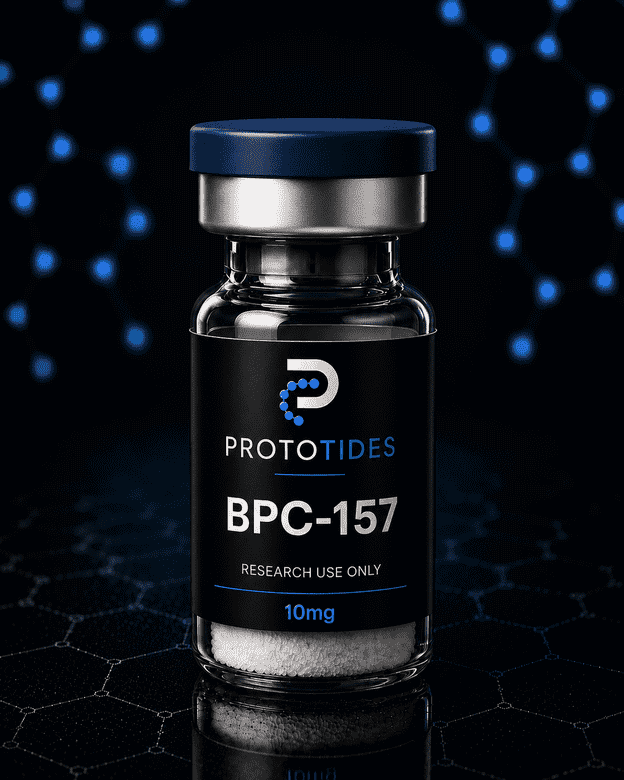
This profile is a documentation-focused reference for BPC-157 as a research material. It describes what the molecule is, how its identity and purity are characterized analytically, what documentation accompanies each lot, and the storage and handling considerations a laboratory typically records. It is written for the researcher evaluating a material on paper — not as a description of any use, effect, or application, and it makes no such claims.
For the commercial listing, current presentations, and lot-specific values, see the BPC-157 product page. This article complements that page with the analytical and documentation context behind the figures.
Molecular Identity and Structure
BPC-157 is a synthetic pentadecapeptide — a chain of fifteen amino-acid residues assembled by solid-phase peptide synthesis. Its sequence corresponds to a partial fragment of a protein described in the scientific literature in association with gastric juice. As a fully defined synthetic sequence rather than a biological extract, it can be reproduced consistently from lot to lot, which is what makes batch-to-batch analytical comparison meaningful.
The molecule is catalogued under CAS registry number 137525-51-0, with the molecular formula C62H98N16O22 and a reported mass of approximately 1419.5 Da. These identifiers are the fixed reference points against which an individual lot's measured mass is checked.
Specifications at a Glance
The following reference values describe the material as characterized. Lot-specific figures are always those printed on the accompanying Certificate of Analysis, which takes precedence over any general reference.
| Attribute | Reference value |
|---|---|
| CAS number | 137525-51-0 |
| Molecular formula | C62H98N16O22 |
| Reported mass | ~1419.5 Da |
| Sequence length | 15 residues (pentadecapeptide) |
| Physical form | White lyophilized powder |
| Identity method | LC-MS |
| Purity method | RP-HPLC (area %) |
| Storage | -20 °C, protected from light |
| Classification | Research use only |
Analytical Characterization
Two complementary, orthogonal methods are used to characterize each lot, because each answers a different question.
Purity — reverse-phase HPLC
Reverse-phase high-performance liquid chromatography (RP-HPLC) separates the target peptide from synthesis-related impurities and reports purity as an area-percent value for the tested sample under the stated method. A purity figure is interpretable only alongside the method and reporting conditions that produced it.
Identity — LC-MS
Liquid chromatography–mass spectrometry (LC-MS) confirms that the material is the intended sequence by measuring its molecular mass and comparing it to the theoretical mass calculated from the fifteen-residue formula. The distinction between these two methods — purity versus identity — is covered in detail in how identity and purity are verified.
Documentation and Lot Traceability
Each lot is supplied with documentation that ties the physical material to its analytical record:
- A Certificate of Analysis recording the lot's purity result, mass confirmation, and release date — read it as evidence about a tested sample, as described in our guide to Certificates of Analysis.
- The RP-HPLC purity report supporting the figure on the COA.
- An independent third-party analytical report, produced by a separate laboratory, providing a second line of documentation.
The unique lot identifier is the thread connecting these records to the container, the order, and inventory. How that identifier underpins traceability is covered in batch traceability and lot documentation.
Storage and Handling Considerations
As a lyophilized peptide, BPC-157 is stored at -20 °C and protected from light. The freeze-dried solid is the stable reference form; once a stock is reconstituted with an aqueous solvent appropriate to the protocol, common laboratory practice is to divide it into single-use aliquots and minimize freeze–thaw cycles, which helps preserve a consistent analytical reference between measurements. Reconstitution solvent, working concentration, and the storage of any prepared solution are determined by the researcher against the requirements of the specific experiment.
Research Context
BPC-157 appears in the laboratory research literature as a synthetic peptide of interest. This profile intentionally does not describe, summarize, or imply any biological activity, effect, outcome, or application, and nothing here should be read as doing so. Any research use is defined and bounded by the investigating laboratory's protocols, institutional SOPs, and applicable safety and regulatory requirements.
What This Profile Does and Does Not Establish
This is a documentation reference. It does not, on its own, establish any of the following:
- That the material is appropriate for a specific research workflow — suitability is a laboratory determination made against institutional SOPs.
- That every unit in a shipment is identical to a tested sample; analysis is performed on a sample, not on each container.
- Any biological effect, activity, or outcome — none is claimed or implied.
- Fitness for human or veterinary use, diagnosis, treatment, or consumption. BPC-157 is supplied for laboratory research use only.
Key Takeaways
- BPC-157 is a synthetic 15-residue peptide (CAS 137525-51-0; ~1419.5 Da), supplied as a lyophilized powder for research use only.
- Identity is confirmed by LC-MS; purity is reported by RP-HPLC — two distinct, complementary methods.
- Each lot carries a COA, an RP-HPLC purity report, and an independent third-party report, tied together by a lot identifier.
- Reported values describe a tested sample under stated methods — not suitability, uniformity, or any use.