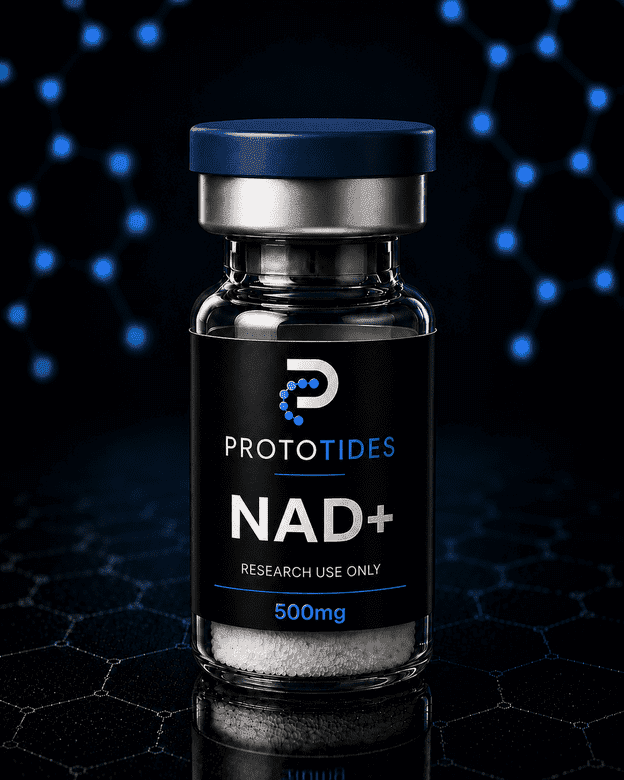
This profile is a documentation-focused reference for NAD+ as a research material. It sets out the molecule's identity, how each lot is characterized analytically, the documentation supplied, and the storage and handling considerations a laboratory typically records. It is written for evaluating a material on paper — not as a description of any use, effect, or application, and it makes no such claims.
For current presentations and lot-specific values, see the NAD+ product page. This article provides the analytical and documentation context behind those figures.
Molecular Identity and Structure
NAD+ (nicotinamide adenine dinucleotide) is a dinucleotide coenzyme — two nucleotides, one bearing adenine and one bearing nicotinamide, joined through a pair of phosphate groups. It is present in living cells, where it participates in cellular redox reactions as a general feature of cellular biochemistry. Unlike the peptides elsewhere in the catalog, it is a nucleotide compound rather than an amino-acid chain.
It is catalogued under CAS registry number 53-84-9, with the molecular formula C21H27N7O14P2 and a reported mass of approximately 663.4 Da.
Specifications at a Glance
The following reference values describe the material as characterized. Lot-specific figures are always those printed on the accompanying Certificate of Analysis, which takes precedence over any general reference.
| Attribute | Reference value |
|---|---|
| CAS number | 53-84-9 |
| Molecular formula | C21H27N7O14P2 |
| Reported mass | ~663.4 Da |
| Compound class | Dinucleotide coenzyme |
| Physical form | White to off-white lyophilized powder |
| Identity method | LC-MS |
| Purity method | RP-HPLC (area %) |
| Storage | -20 °C, protected from light and moisture |
| Classification | Research use only |
Analytical Characterization
Two complementary, orthogonal methods characterize each lot.
Purity — reverse-phase HPLC
Reverse-phase HPLC separates the coenzyme from related species and degradation products and reports purity as an area-percent value for the tested sample under the stated method.
Identity — LC-MS
LC-MS confirms identity by matching the measured mass to the theoretical value for the dinucleotide. The distinction between purity and identity is explained in how identity and purity are verified.
Documentation and Lot Traceability
Each lot is supplied with a Certificate of Analysis recording purity, mass confirmation, and release date (see the guide to Certificates of Analysis), the supporting RP-HPLC purity report, and an independent third-party analytical report. A unique lot identifier ties these records to the physical material.
Storage and Handling Considerations
NAD+ is stored as a lyophilized powder at -20 °C, protected from both light and moisture, conditions that help limit hydrolysis and preserve the integrity of the coenzyme. Because it can hydrolyze in solution over time, working solutions are commonly prepared shortly before use rather than stored at room temperature, and aliquots are kept frozen with only the needed portion thawed. Solvent, concentration, and handling are determined by the researcher against the protocol; general principles are covered in research material storage practices.
Research Context
NAD+ is studied across many areas of cellular biochemistry. This profile intentionally does not describe, summarize, or imply any biological effect, outcome, or application of the supplied material in any organism. Any research use is defined and bounded by the investigating laboratory's protocols, institutional SOPs, and applicable safety and regulatory requirements.
What This Profile Does and Does Not Establish
This is a documentation reference. It does not, on its own, establish any of the following:
- That the material is appropriate for a specific research workflow — suitability is a laboratory determination made against institutional SOPs.
- That every unit in a shipment is identical to a tested sample; analysis is performed on a sample, not on each container.
- Any biological effect, activity, or outcome — none is claimed or implied.
- Fitness for human or veterinary use, diagnosis, treatment, or consumption. NAD+ is supplied for laboratory research use only.
Key Takeaways
- NAD+ is a dinucleotide coenzyme (CAS 53-84-9; ~663.4 Da), supplied as a lyophilized powder for research use only.
- It is characterized by the same methods as the peptides — RP-HPLC for purity, LC-MS for identity — but is a nucleotide, not a peptide.
- Moisture control and cold storage are emphasized because the coenzyme can hydrolyze over time.
- Each lot carries a COA, an RP-HPLC purity report, and an independent third-party report tied by a lot identifier.