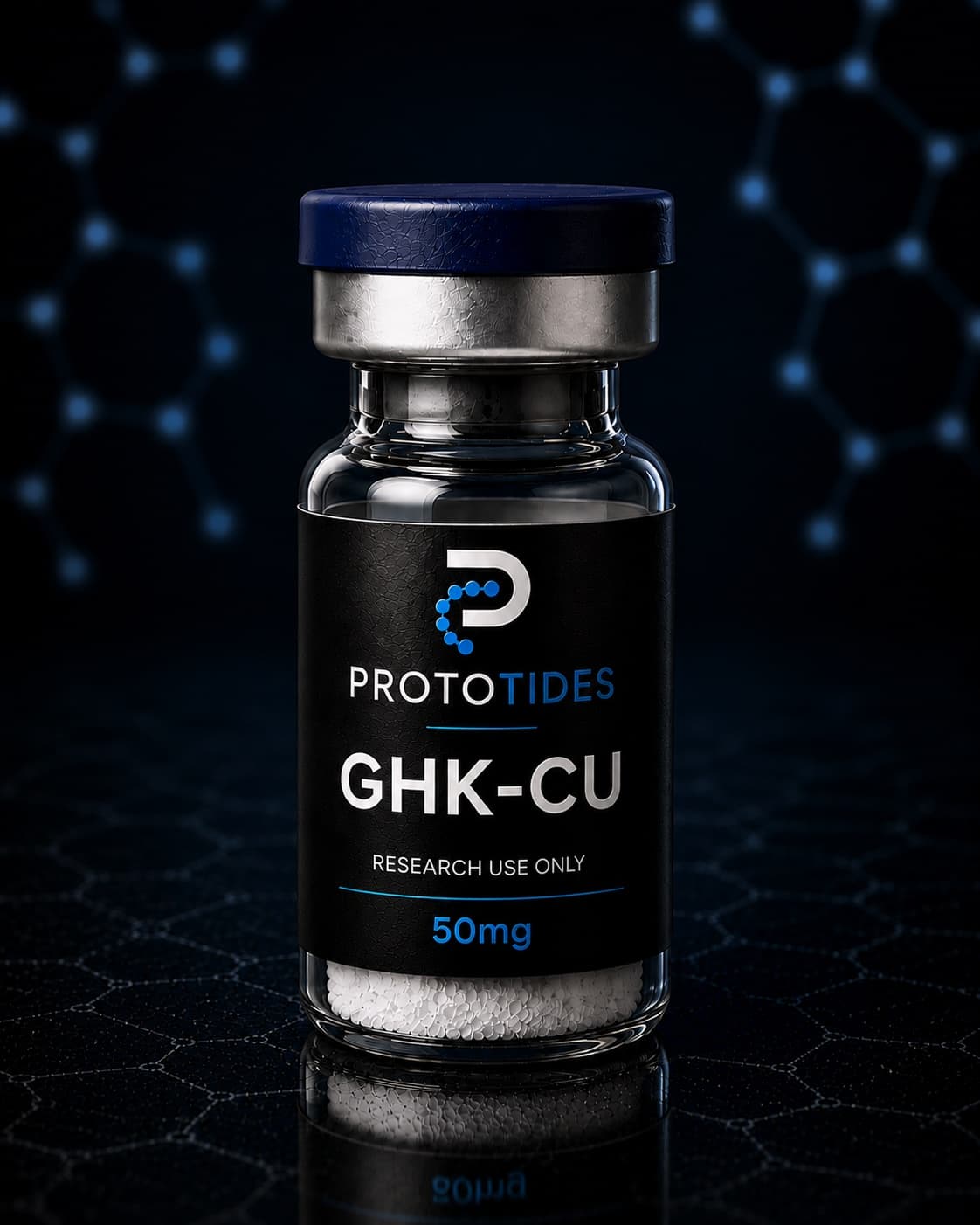
This profile is a documentation-focused reference for GHK-Cu as a research material. It sets out the molecule's identity, how each lot is characterized analytically, the documentation supplied, and the storage and handling considerations a laboratory typically records. It is written for evaluating a material on paper — not as a description of any use, effect, or application, and it makes no such claims.
For current presentations and lot-specific values, see the GHK-Cu product page. This article provides the analytical and documentation context behind those figures.
Molecular Identity and Structure
GHK-Cu is a copper(II)-binding tripeptide complex — the sequence glycyl-L-histidyl-L-lysine coordinated to a copper ion. The peptide was originally described in the scientific literature as a sequence isolated from human plasma; the supplied material is the defined synthetic complex. The histidine residue provides the principal coordination site for the bound copper.
It is catalogued under CAS registry number 89030-95-5, with the molecular formula C14H24CuN6O4 and a reported mass of approximately 403.9 Da. Unlike the uncomplexed peptides in the catalog, GHK-Cu includes a coordinated metal, which is reflected both in its formula and in its characteristic appearance.
Specifications at a Glance
The following reference values describe the material as characterized. Lot-specific figures are always those printed on the accompanying Certificate of Analysis, which takes precedence over any general reference.
| Attribute | Reference value |
|---|---|
| CAS number | 89030-95-5 |
| Molecular formula | C14H24CuN6O4 |
| Reported mass | ~403.9 Da |
| Composition | Gly-L-His-L-Lys tripeptide + Cu(II) |
| Physical form | Blue lyophilized powder |
| Identity method | LC-MS |
| Purity method | RP-HPLC (area %) |
| Storage | -20 °C, protected from light |
| Classification | Research use only |
Analytical Characterization
Two complementary, orthogonal methods characterize each lot.
Purity — reverse-phase HPLC
Reverse-phase HPLC separates the target complex from related species and reports purity as an area-percent value for the tested sample under the stated method.
Identity — LC-MS
LC-MS confirms identity by matching the measured mass to the theoretical value for the tripeptide–copper complex — the coordinated copper is part of what the mass measurement accounts for. The distinction between the two methods is explained in how identity and purity are verified, and the role of a separate laboratory in independent third-party verification.
Documentation and Lot Traceability
Each lot is supplied with a Certificate of Analysis recording purity, mass confirmation, and release date (see the guide to Certificates of Analysis), the supporting RP-HPLC purity report, and an independent third-party analytical report. A unique lot identifier ties these records to the physical material.
Storage and Handling Considerations
GHK-Cu is stored as a lyophilized powder at -20 °C, protected from light — conditions that help maintain the integrity of the copper-coordinated complex. On reconstitution into a mild, near-neutral aqueous solvent, researchers commonly confirm that the solution retains its characteristic blue tint, since a change in color can indicate disrupted coordination. Reconstituted solutions are typically aliquoted and kept cold; solvent, concentration, and handling are determined by the researcher against the protocol.
Research Context
GHK-Cu appears in the laboratory research literature as a copper-binding peptide of interest. This profile intentionally does not describe, summarize, or imply any biological activity, effect, outcome, or application. Any research use is defined and bounded by the investigating laboratory's protocols, institutional SOPs, and applicable safety and regulatory requirements.
What This Profile Does and Does Not Establish
This is a documentation reference. It does not, on its own, establish any of the following:
- That the material is appropriate for a specific research workflow — suitability is a laboratory determination made against institutional SOPs.
- That every unit in a shipment is identical to a tested sample; analysis is performed on a sample, not on each container.
- Any biological effect, activity, or outcome — none is claimed or implied.
- Fitness for human or veterinary use, diagnosis, treatment, or consumption. GHK-Cu is supplied for laboratory research use only.
Key Takeaways
- GHK-Cu is a copper(II)-binding tripeptide complex (CAS 89030-95-5; ~403.9 Da), supplied as a blue lyophilized powder for research use only.
- Identity is confirmed by LC-MS against the complex mass; purity is reported by RP-HPLC.
- The blue color is a first-glance indicator that the copper coordination is intact.
- Each lot carries a COA, an RP-HPLC purity report, and an independent third-party report tied by a lot identifier.