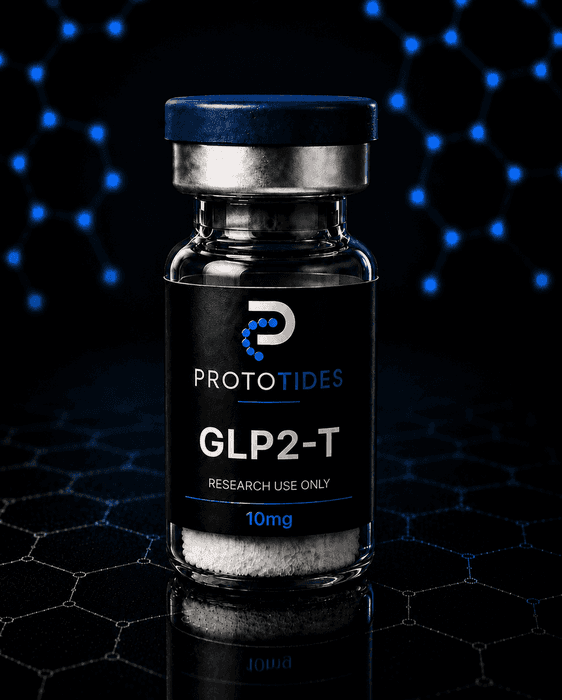
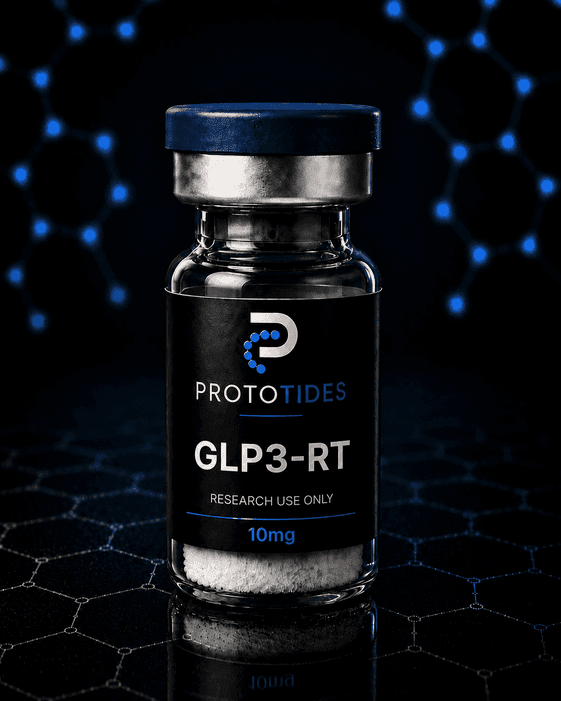
GLP2-T and GLP3-RT are both synthetic peptides that the Prototides catalog groups under Metabolic Research. They are the closest pair in the catalog by sequence length — both are thirty-nine residues — which makes the differences between them a matter of composition and receptor-target classification rather than scale. This reference compares what each molecule is and how each lot is characterized and documented.
It does not compare — and does not describe or imply — any biological effect, activity, outcome, or application of either compound, and neither is presented as preferable to the other. Both are supplied strictly for laboratory research use.
At a Glance
Reference values for each molecule. Lot-specific figures are always those printed on the accompanying Certificate of Analysis, which takes precedence over any general reference.
| Attribute | GLP2-T | GLP3-RT |
|---|---|---|
| CAS number | 2023788-19-2 | 2381009-26-1 |
| Molecular formula | C225H348N48O68 | C256H398N64O76 |
| Reported mass | ~4813.5 Da | ~5765.5 Da |
| Sequence length | 39 residues | 39 residues |
| Structural class | Incretin-mimetic; dual GIP/GLP-1 receptor co-agonist | Incretin-mimetic; triple GIP/GLP-1/glucagon receptor tri-agonist |
| Category | Metabolic Research | Metabolic Research |
| Identity method | LC-MS | LC-MS |
| Purity method | RP-HPLC (area %) | RP-HPLC (area %) |
| Physical form | White lyophilized powder | White lyophilized powder |
| Storage | -20 °C, protected from light | -20 °C, protected from light |
| Classification | Research use only | Research use only |
How the Molecules Differ Structurally
Both compounds are thirty-nine-residue synthetic peptides assembled by solid-phase peptide synthesis, and both belong to the incretin-mimetic structural class. Where they part company is composition and receptor-target classification. GLP2-T is described as a dual GIP/GLP-1 receptor co-agonist with a mass of approximately 4813.5 Da. GLP3-RT is described as a triple GIP/GLP-1/glucagon receptor tri-agonist and is appreciably heavier at approximately 5765.5 Da.
The mass difference is worth understanding correctly: sequence length counts residues, not mass. Two peptides of equal length can differ substantially in molecular mass depending on which amino acids occupy each position, because individual residues carry different masses. The roughly 950 Da gap here reflects composition, not chain length. These receptor-class descriptions are structural and receptor-target categories, noted without any associated effect claim. For the full per-compound treatment, see the GLP2-T research profile and the GLP3-RT research profile.
How Each Is Characterized
The analytical approach is identical for both:
- RP-HPLC separates the target peptide from synthesis-related impurities and reports purity as an area-percent value for the tested sample under a stated method.
- LC-MS records the molecular profile by mass, confirming it against the expected value for the preparation.
At thirty-nine residues each, both place a comparable burden on the separation — this is the one pair in the catalog where chain length is not a differentiating analytical factor. The distinction between the two questions these methods answer is covered in how identity and purity are verified.
Documentation — Where It Carries Extra Weight
Both are proprietary research preparations, which means their specifics are documented per lot rather than published as a general datasheet. That makes the lot-specific Certificate of Analysis the authoritative specification for either compound — the records carry more weight here than for a compound with a widely published reference profile. Each lot ships with:
- A Certificate of Analysis recording the lot's purity result, mass confirmation, and release date — see the guide to Certificates of Analysis.
- The RP-HPLC purity report supporting the figure on the COA.
- An independent third-party analytical report from a separate laboratory.
A unique lot identifier ties these records to the physical container, as described in batch traceability and lot documentation.
Storage and Handling
Both are supplied as lyophilized powder, stored at -20 °C and protected from light. The freeze-dried solid is the stable reference form for each; once reconstituted with a solvent appropriate to the protocol, common laboratory practice for both is to divide the stock into single-use aliquots and minimize freeze–thaw cycles. Reconstitution solvent, working concentration, and storage of any prepared solution are determined by the researcher against the requirements of the specific experiment — see cold-chain and -20 °C storage.
What This Comparison Does and Does Not Establish
This is a structural and documentation reference. It does not, on its own, establish any of the following:
- That either compound is more effective, more suitable, or preferable to the other — no effect or activity is claimed for either, so no such comparison is possible or intended.
- Any biological effect, activity, or outcome for either material — none is claimed or implied. Receptor-class descriptors are structural categories, not statements of effect.
- That either material is appropriate for a specific research workflow — suitability is a laboratory determination made against institutional SOPs.
- Fitness for human or veterinary use, diagnosis, treatment, or consumption. Both are supplied for laboratory research use only.
Key Takeaways
- GLP2-T and GLP3-RT are both 39-residue synthetic peptides in the incretin-mimetic class; they differ in composition and receptor-target classification, not chain length.
- GLP2-T is ~4813.5 Da (dual GIP/GLP-1 co-agonist); GLP3-RT is ~5765.5 Da (triple GIP/GLP-1/glucagon tri-agonist).
- Both are proprietary preparations, so the lot-specific COA is the authoritative specification rather than a published datasheet.
- This reference compares molecules and records only. No effect, activity, or superiority is claimed or implied for either.